Project Management Professional (PMP)
Information on my personal preparation and perspective on pursuing and achieving the PMP Certification.
Since achieving my Project Management Professional (PMP) through the Project Management Institute (PMI) in May of 2015, I've had many friends and colleagues ask me about the process I employed to prepare and ultimately be successful in my pursuit. This page is intended to consolidate some of this information and the approach I personally employed to be successful. I would encourage anyone considering pursuing a PMP to read the following, search for other perspectives, and then plot your own course towards applying, sitting for, and achieving your PMP.
My Preparation Steps
- Read and review the PMI PMP Handbook — This will prepare you to what the requirements are for eligibility (Page 9), application, and holding up to a PMI audit if randomly selected.
- Purchase an annual PMI Membership — This gives you access to webinars (through ProjectManagement.com), the PMBOK, and other resources; as well as save you $150 on the PMP exam fee (net savings of ~$20: $130 for membership, $555 without membership, $405 with = $535 total).
- Apply — If you meet or exceed the requirements (see Page 9 of the Handbook). Pay special attention to how PMI asks you to summarize experience. I inadvertently clustered project experience at a program level — resulted in an audit and no-fault denial costing me $100 and requiring reapplication.
- Take a Preparation Course or Read a Text — I personally used and highly recommend PMP Exam Prep, Eighth Edition by Rita Mulcahy. It perfectly filled the void of information I'd expect from an in-person course while affording me the luxury of moving through it self-paced.
- Create a Study Guide and Cheat Sheet — I re-read Rita Mulcahy and created a study guide broken out by chapter. The process of outlining notes assists me in forming mental models of information.
- Read the Project Management Book of Knowledge (PMBOK) — I read through a full print out downloaded from PMI (free with membership).
- Re-reviewed PMP Exam Prep by Rita Mulcahy — Re-reviewed the book to see if I picked up anything new given the newly acquired context from the PMBOK.
- Re-read the PMBOK — The PMBOK is dry and dry material often requires multiple passes to ensure pertinent information has been captured.
- Chapter Practice Quizzes — Worked through the practice quizzes at the conclusion of each chapter of Rita Mulcahy's book.
- Four-Hour Practice Exam — I personally did not do this, but most preparation material highly recommends it to ensure mental endurance. I'd especially emphasize it if you have a gap since higher education or haven't taken certification exams recently.
- Sit and Pass Your Exam — I did a brain dump onto scratch paper first, then moved through at a quicker pace and answered uncertain questions with my gut response, flagging them for later review. After ~90 minutes I took an ~8-minute break, then returned with fresh eyes. Read the full question — I had a large portion of questions where one portion materially changed how I responded.
Resource List
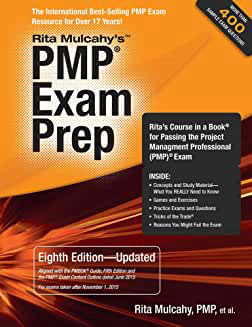
PMP Exam Prep, Eighth Edition — Rita Mulcahy
Available on Amazon. Rita Mulcahy sadly passed away in 2010, but a 9th edition is now available.
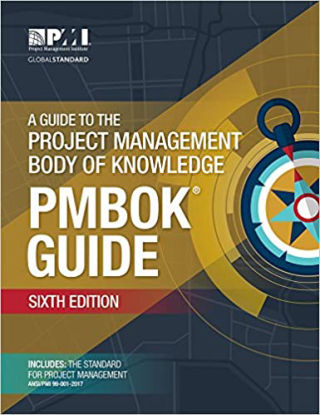
Project Management Book of Knowledge (PMBOK)
Also available for purchase on Amazon.
My Perspective on Value and Benefit
The PMP is not for everyone. Some see it as a ticket to entry into specific roles; others see it as a logical and rewarding contribution to the project management trade craft. My motivations were multi-part: I knew having a PMP would be an increasing price of entry as I looked to grow my career, and it was a knowledge domain that would be valuable regardless of future career path. The PMP can be seen as a short-term effort that stops after passing the exam, or it can be seen as a great learning opportunity — one that starts a journey of continuous learning and usefulness in your career.
What was your experience completing the PMP?
My experience was overall great. My employer at the time wouldn't sponsor the exam unless you were of a specific career level with a customer requirement, so I put a chip on my shoulder and did it via self-study and self-funding. It took about 12–14 months to move from exam book purchase to passing, including multiple "false starts." Near the end of this period I took a similar intense approach to what I'd used for my AWS Solutions Architect certification — 2–3 months of most nights, weekends, and "free" time at work. Approaching it this way was very rewarding and made the accomplishment that much more significant.
How has this benefited you in your career?
The certification itself is increasingly a basic or preferred qualification to jobs with a project management component; having it eliminates that barrier to entry. More impactful was the knowledge gained through the pursuit. There are certification holders who achieved it and then let the knowledge lapse — I'd encourage you to evaluate your motives. If you pursue it as a genuine learning investment, the certification and continuing education requirements will continue to yield benefits for years to come.
What kinds of opportunities did PMP open up for you?
I haven't seen too many direct opportunities from it, but there are certainly secondary and tertiary benefits. The more direct benefit was the knowledge gained from the pursuit rather than the credential itself. No matter what, both will serve as a differentiator and a major tool as you ascend in your career. We all manage projects in some way — only the scope, scale, and formality differ.
What would your advice be for transitioning from technical support into project management?
Seek opportunities — at your employer or via local PMI Chapters — to gain exposure. That is how I made the pivot: I let my management know my interest and gradually grew into a project controls team doing financial and schedule management. Be vocal if you believe your manager(s) will be supportive. Even if not yet pursuing a PMP (perhaps due to experience requirements), I'd look into PMI's associate credential or CompTIA Project+. These give you additional education and begin to signal to employers and recruiters that you've invested in yourself.
Are there industry terms for these types of roles?
Certainly not an exhaustive list: Project Manager, Project Analyst, Project Coordinator, Program Manager, Program Management Analyst, Engagement Manager, Project Leader, and Agile roles (Product Owner, Scrum Master, etc.). I'd also recommend checking out this list by projectmanager.com.